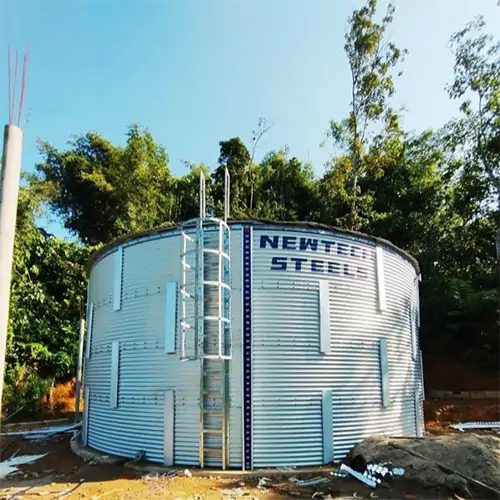
One of the major needs of residential, commercial and industrial infrastructure is a reliable water storage system. The Overhead Water Tank remains the efficient and most commonly used system of ensuring continued water pressure and supply today among the available numerous solutions. This system is highly important in water management since it is applied in high-rise buildings, manufacturing plants, and so on.
As the cities are becoming increasingly urbanized, and the needs in water are increasing, the selection of the appropriate choice of elevated storage becomes not only possible but also a must. This is an in-depth guide to understanding all about overhead water storage systems such as its structure, advantages, materials, usage, and maintenance. This information will be used to guide engineers, builders, facility managers, and decision-makers to the most dependable solution in terms of long-term performance.
What Is an Overhead Water Tank?
An Overhead Water Tank is a water storage tower mounted high above the ground above the roofline or steel scaffolder staging to provide water through the force of gravity. In comparison to underground or ground level tanks, elevated systems maintain stable pressure of water without necessarily employing continuous pumping to maintain water pressure.
This kind of storage is necessary to keep water available in case of power outage, peak period, or when there is an irregular supply by municipalities. Its design is designed in such a way that it allows the flow of water to flow downwards in a natural manner which makes it efficient and reliable.
Why Overhead Water Storage Is Essential Today
The contemporary infrastructure needs continuous water supply as a social need in everyday activities, personal hygiene, fire prevention, and industrial water consumption. There are several benefits of elevated systems of storage which render them unavoidable:
- Constant water pressure in the absence of electricity
- Reduced dependency on pumps
- Water distribution in a very effective way, among the floors
- The availability of water in emergency situations
- Space optimization
The advantages of Overhead Water Tank make them suitable in residential apartment buildings, hospitals, hotels, factories, educational and commercial complexes.
Types of Overhead Water Tanks Based on Material
The correct material selection is important in terms of performance, duration of life, and water safety. The most common used materials are listed below:
1. Steel Tanks
The steel Overhead Water Tank is more used in the industry and large scale usage because it is very strong, promotes long life and endurance to extreme conditions.
2. Zinc Aluminium Tanks
These tanks are highly corrosive resistant and suit areas that are humid or salty.
3. Concrete Tanks
They are primarily used in large buildings and need more maintenance and time to be constructed.
4. Plastic (Polymer) Tanks
Widely used in the home and with low durability and capacity.
Comparison Table: Tank Materials
| Material Type | Durability | Corrosion Resistance | Maintenance | Ideal Usage |
| Steel | Very High | High (with coating) | Low | Industrial & Commercial |
| Zinc Aluminium | Very High | Excellent | Very Low | Long-term Storage |
| Concrete | High | Moderate | High | Large Buildings |
| Plastic | Moderate | Good | Moderate | Residential |
Structural Design and Engineering Considerations
Overhead Water Tank should be constructed with a high level of precision engineering in order to provide performance and safety. Key design aspects include:
- Load-bearing capacity
- Wind and seismic resistance
- Base and staging strength
- Computations of water pressure
- Anti-corrosion treatment
The Overhead Water Tank production at Newtech Steels Industries Private Limited is done through modern fabrication methods and controlled material to address both the Indian and global requirements.
Applications Across Industries
Residential Buildings
Provides water perenniality even in case of scarcity.
Commercial Spaces
Applied in malls, offices, and hotels where the demand of water varies during the day.
Industrial Facilities
Serves to support manufacturing processes, cooling systems and cleaning activities.
Fire Safety Systems
Serves as a dependable backup source of fire-fighting needs.
Healthcare & Education
Holds standards of hygiene and continuous operation.
Advantages of Using Steel Overhead Tanks
Overhead Water Tank systems made of steel are becoming the most popular because of the unmatched advantages:
- Long service life (25+ years)
- High structural strength
- Hygienic water storage
- Carefree inspection and cleaning
- Easily adjustable capacity and sizes
The benefits of steel tanks enable it to be an economical long-term investment.
Capacity Selection Guide
The appropriate choice of the capacity depends on the use habits and application:
| Application | Recommended Capacity |
| Individual Home | 500 – 2000 Litres |
| Apartment Complex | 10,000 – 50,000 Litres |
| Commercial Building | 20,000 – 1,00,000 Litres |
| Industrial Unit | Custom-designed |
Installation Best Practices
Safety and performance: Proper installation will guarantee this.
- Install certified structural staging
- Ensure level foundation
- Install overflow and venting systems
- Apply anti-rust coatings
- Conduct load testing
It is highly encouraged to avoid structural risks and professionally install it.
Maintenance and Safety Guidelines
An Overhead Water Tank needs very few maintenance procedures, but it does not last long without regular inspection:
- Clean inside surfaces on a regular of 6–12 periods
- Check against corrosion or leakage
- Check inlet, out-flow and overflow pipes
- Protective coatings – Make sure they are intact
Regular monitoring is used to preserve the quality of water and its structural integrity.
Sustainability and Water Conservation
The contemporary raised tanks help in harvesting rain water and cutting down on water waste. The steel Overhead Tank can be recycled and hence is an environmental-safe alternative. Evaporation and leakage of water can greatly be minimized with the right design.
Why Choose Newtech Steels Industries Private Limited?
Newtech steels industries private limited production accuracy engineered water storage systems which are intended to be reliable over an extended period. Their Overhead Water Tank systems are made using the high grade of steel, high quality of coatings, and rigorous quality control measures.
Key strengths include:
- Bespoke production facilities
- The adherence to industry standards
- Corrosion and long-lasting corrosion protection
- Expert technical support
They are trusted in their solutions both in residential, commercial, and industrial solutions.
Conclusion
The Overhead Water Tank is still one of the most effective and safe water storage systems of the modern infrastructure. The fact that it provides steady pressure, minimizes power reliance, and facilitates mass water demands makes it essential in industries.
Getting a high quality steel solution that is a reputable manufacturer such as Newtech Steels Industries Private Limited means durability, safety, and long term value. An elevated water storage system designed with excellence of its design is an investment in sustainability and efficiency in its operations, whether at home or an industry.
Frequently Asked Questions (FAQ)
1. How long does an overhead water storage system last?
With proper material selection and maintenance, steel tanks can last over 25 years.
2. Is steel safe for drinking water storage?
Yes. Food-grade coatings ensure hygienic and contamination-free storage.
3. Can these tanks be customized?
Yes, capacity, height, and design can be customized based on project needs.
4. How often should cleaning be done?
Cleaning is recommended once or twice a year depending on usage.
5. Are elevated tanks suitable for seismic zones?
When designed correctly, they are safe and compliant with seismic standards.